


Church LED Video Walls: Indoor & Outdoor LED Displays for Austin Houses of Worship
- Nate Cake
- Aug 24
- 7 min read

Churches throughout Austin and Central Texas are increasingly replacing traditional projection systems with direct-view LED video walls. From song lyrics and scripture to live camera feeds, sermon graphics, and livestream production, today's church video system has become an integral part of the worship experience.
At Benchmark Audiovisual, we design and install indoor and outdoor LED video walls and complete church AV systems throughout the Austin metro, including Cedar Park, Georgetown, Leander, Bee Cave, Lakeway, West Lake Hills, Rollingwood, Barton Creek, Spanish Oaks, and surrounding Central Texas communities.
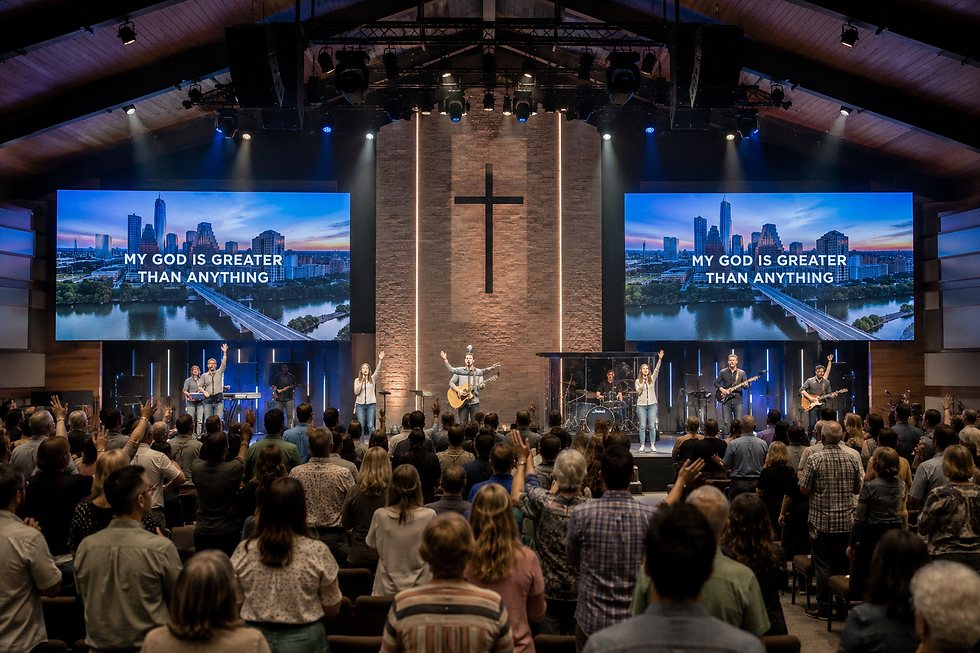
Modern church sanctuary with two large-format LED video walls providing clear visibility for worship content, live video, and presentations.
The key to a successful LED wall isn't simply buying the biggest or highest-resolution display available. Pixel pitch, viewing distance, brightness, sightlines, cameras, structural support, electrical requirements, serviceability, and budget all need to be considered together.
Why Are Churches Choosing LED Video Walls?
For decades, projection was the standard solution for large-format church video, and a properly designed laser projection system can still be an excellent choice.
But projection has limitations.
A projector has to compete with ambient light and stage lighting. The image can become washed out, people can cast shadows across the screen, and the room must provide appropriate projector locations, throw distances, and sightlines.
Direct-view LED produces the image at the display itself. This allows an LED video wall to produce exceptional brightness, contrast, and color without requiring a dark sanctuary.
For churches, an LED video wall can display:
Worship lyrics and scripture
Sermon notes and graphics
Live camera feeds and IMAG
Announcements and prerecorded video
Livestream and broadcast content
Creative worship backgrounds
Special events and presentations
LED is also modular. Instead of being limited to the dimensions of a television or projection screen, an LED video wall can be engineered around the church's architecture.
Understanding Pixel Pitch: 2.5mm, 2.9mm, 3.9mm and Beyond
Pixel pitch is one of the most important specifications when designing a church LED video wall.
Pixel pitch is the distance, measured in millimeters, between adjacent LED pixels. The smaller the number, the closer together those pixels are.
That means a smaller pixel pitch creates greater pixel density and higher resolution for a given screen size, allowing viewers to sit closer to the display before individual pixels become noticeable.
But there is an important tradeoff:
Smaller pixel pitch costs more.
More pixels mean more LEDs, more components, and greater manufacturing complexity. Paying for an extremely fine-pitch LED wall when the congregation is viewing it from 40, 60, or 100 feet away may add considerable expense without providing a meaningful visual improvement from the seats.
What Pixel Pitch Is Best for a Church?
While every sanctuary is different, 2.5mm and 2.9mm are excellent starting points for many indoor church LED video walls, particularly when the congregation is viewing a large display from typical sanctuary distances.
For outdoor church LED walls, where viewers are generally farther away, 3.9mm is often an excellent starting point.
For smaller sanctuaries or installations where the first row is very close to the display, we may recommend a finer pitch such as 1.5mm, 1.8mm or 1.9mm. Very large venues or long-distance outdoor applications may allow a larger pitch.
The important point is this:
The most expensive pixel pitch isn't necessarily the best pixel pitch.
Benchmark Audiovisual evaluates the closest seating position, farthest seating position, overall wall dimensions, and type of content being displayed before recommending a solution.
Designing an LED Wall Around Your Church's Budget
LED video walls can represent a substantial investment, and we understand that churches have very different budgets.
Benchmark Audiovisual's goal is to determine where your money actually improves the worship experience.
In some rooms, investing in finer pixel pitch makes sense. In another sanctuary, a 2.5mm or 2.9mm display viewed from farther away may look outstanding while reducing the overall project cost.
We do our best to work with a wide range of church budgets, designing the right balance between screen size, pixel pitch, performance, infrastructure, and long-term reliability.
Rather than simply specifying the highest-resolution product available, we want to build a video system that makes financial and technical sense for your church.
Viewing Distance and Viewing Angle Matter
Pixel pitch and viewing distance go hand in hand.
As viewers get closer to an LED wall, finer pixel pitch becomes increasingly important. As viewing distance increases, larger pixel pitches can still produce a beautiful, seamless image.
Viewing angle matters too.
Austin-area churches often have wide sanctuaries with seating extending significantly to the left and right of the stage. A display that looks fantastic from the front-of-house position isn't enough if large portions of the congregation are viewing it from an extreme angle.
That's why Benchmark Audiovisual evaluates the entire seating area, not simply the centerline of the room.

Dual LED video walls at The Grove Church in Liberty Hill, Texas, provide clear views of worship content throughout the sanctuary.
Why Refresh Rate Matters for Church Cameras
For churches that livestream or use IMAG, LED refresh rate is extremely important.
We typically look for professional LED systems capable of approximately 3,840 Hz or greater, depending on the application.
An LED wall may look perfect to the human eye but produce flicker, scan lines, or artifacts when viewed through a camera if the display and video system aren't properly designed.
This is why LED wall design should consider the church's complete production environment, including cameras, video switching, processing, livestreaming and stage lighting.
Indoor vs. Outdoor Church LED Video Walls
Indoor and outdoor LED systems have very different requirements.
Indoor church LED walls typically prioritize fine pixel pitch, color accuracy, camera performance, appropriate brightness, and quiet operation.
Outdoor church LED walls must contend with direct sunlight, Texas heat, humidity, rain, dust, and dramatic temperature changes. They generally require much higher brightness and appropriately weather-rated components.
For outdoor worship areas, LED has another major advantage over projection: daylight visibility.
A projector that looks fantastic after sunset may struggle during a Sunday morning outdoor service. A properly designed outdoor LED wall can remain visible during daytime services, community events, concerts, and evening programs.

An outdoor LED video wall provides a bright, large-format image for worship services and community events in a Central Texas church environment.
LED Video Walls vs. Projection
LED isn't automatically the right answer for every church.
Projection may be preferable when:
Initial budget is the primary consideration
Ambient light can be tightly controlled
The church needs a very large image at a lower initial cost
Existing architecture already supports projection
LED becomes especially attractive when:
Ambient light is difficult to control
The church wants greater brightness and contrast
Projector shadows are a problem
The room doesn't have an ideal projector location
The display will frequently appear on camera
Outdoor daytime viewing is required
The church wants a cleaner architectural appearance
The real question isn't whether LED is universally better than projection.
It's which technology is best for this church, this room, and this budget.
Planning for LED Wall Maintenance and Minimum Downtime
An LED video wall is a long-term investment, and serviceability should be part of the original design.
Many professional systems use front-serviceable LED modules, allowing individual modules and components to be removed without dismantling the entire display.
At Benchmark Audiovisual, our approach goes a step further.
When we commission an LED video wall, we leave the church with spare LED modules and appropriate spare parts included as part of the project design. If a module eventually fails, having matching replacement components already onsite can dramatically reduce downtime and help get the wall fully operational again as quickly as possible.
Keeping spare modules from the original production batch can also be important. LED technology evolves quickly, and having matching modules available can help maintain consistent color and visual performance if a module needs to be replaced years later.
Preventive LED Wall Maintenance
We recommend having Benchmark Audiovisual perform a preventative maintenance inspection approximately every six months to one year, depending on system usage and operating environment.
During these visits, we can inspect the LED modules and associated hardware, check system performance, evaluate processing and signal integrity, and look for potential issues before they become failures.
The goal is simple:
Find small problems before they become Sunday-morning problems.
Building or Renovating a Church? Bring Benchmark in Early.
If your church is building a new sanctuary or undertaking a major renovation, bring your AV integrator into the project during the architectural and engineering phase.
Early coordination allows Benchmark Audiovisual to work alongside the architect, electrical engineer, structural engineer, and general contractor to answer critical questions before construction:
Where should the LED walls go? How large should they be? What pixel pitch makes sense? Can every seat see them? Where does power go? What structural support is required? Where should conduit, fiber, and network cabling be installed? Where does the video processor live? How will technicians service the displays?
Solving those problems before drywall goes up is usually easier, cleaner, and more cost-effective.
More importantly, it allows us to create a finished system that looks like it was designed as part of the church instead of added afterward.
Already Have a Finished Sanctuary? We Can Retrofit It.
Most churches aren't starting from scratch.
Benchmark Audiovisual can retrofit LED video walls into existing churches, including sanctuaries currently using projection systems.
That can involve custom structural mounting, new electrical circuits, fiber and network cabling, video processing and integration with existing cameras, livestreaming systems and control equipment.
Whether it's new construction or a retrofit, we design the entire system around the building and the way your church actually operates.
Church LED Video Wall Installation in Austin, Texas
Benchmark Audiovisual designs and installs church LED video walls and complete church AV systems throughout Austin and Central Texas, including Austin, Cedar Park, Leander, Georgetown, Round Rock, Bee Cave, Lakeway, West Lake Hills, Rollingwood, Barton Creek, Spanish Oaks, Dripping Springs, Liberty Hill and surrounding communities.
Whether your church is considering an indoor LED video wall, outdoor LED display, projector replacement, or complete church AV upgrade, we can evaluate your sanctuary, viewing distances, infrastructure, production requirements, and budget to determine the right solution.
Our objective isn't simply to sell your church a giant screen.
It's to design a video system that looks incredible, functions properly, can be maintained for years to come, and provides the best possible experience for your congregation.
Considering an LED Video Wall for Your Church?
Contact Benchmark Audiovisual to schedule an on-site consultation for your Austin-area church.
We'll evaluate your space, discuss your budget, and help determine the appropriate display size, pixel pitch, and system design for your sanctuary or outdoor worship environment.
Benchmark Audiovisual
Austin & Central Texas
Church AV Design • Indoor & Outdoor LED Video Walls • Church Audio • Livestreaming • Acoustics • Lighting • Control Systems


Comments